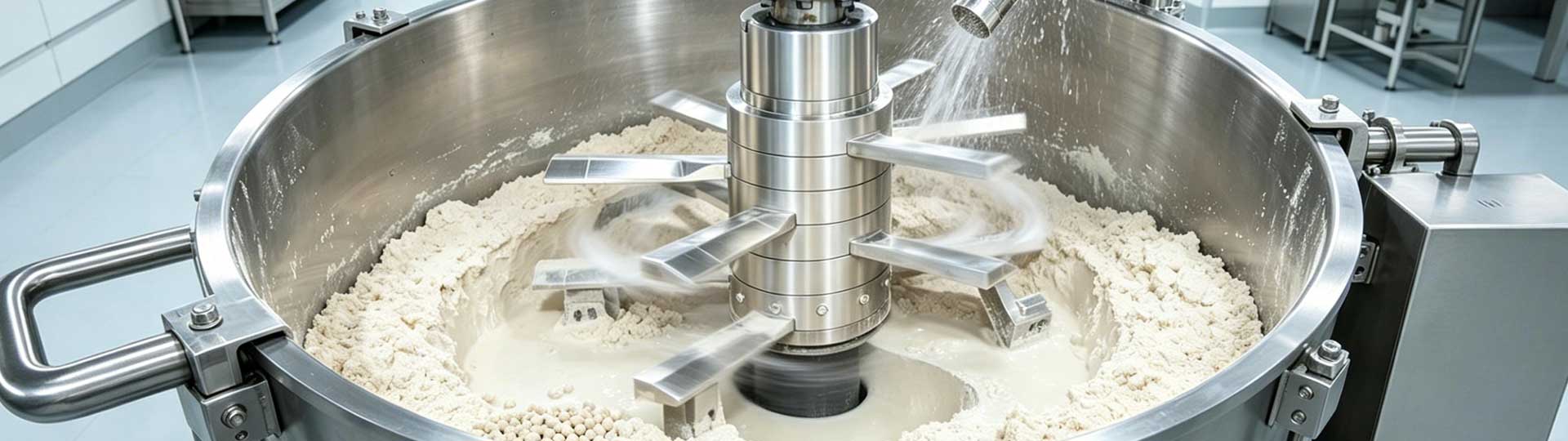
The phrase “high-shear mixer” has become almost meaningless in industrial mixing discourse. Nearly every intensive mixer on the market claims high shear. The technically consequential question is not whether a machine can generate high shear somewhere inside its vessel, but whether it can impose a defined, repeatable, and spatially uniform shear history on every particle in the batch—and whether that history can be changed independently of throughput. Read this way, the Kontex intensive mixer is less a “high-shear device” than a platform on which shear intensity has been converted from a fixed consequence of rotor geometry into a programmable process variable.
Kontex’s counter-current architecture—a forward-rotating pan paired with an eccentrically mounted counter-rotating rotor—produces the familiar triad of convection, shear, and diffusion. What is less often noted is the range over which the shear component can be varied without changing the machine. Published specifications for the KH series place rotor tip speed at continuously adjustable values from 2 to 30 m/s, while the mixing vessel offers selectable speeds of 0.7 m/s or 1.4 m/s. This is not a trivial range. At the low end, the machine operates as a gentle de-agglomerator that opens soft clusters without significantly altering primary particle size. At the high end, it becomes a shear-granulation tool capable of building dense granules from fine powders. The same hardware spans both regimes.-
This matters because the process objective in most real applications is not “maximum shear.” It is a targeted shear exposure: enough stress to break the agglomerates that matter, but not so much that crystal structure, particle morphology, or granule porosity is sacrificed. A machine with a fixed high-shear geometry forces the operator to choose between under-mixing and over-processing. A machine with an adjustable shear spectrum allows the shear history to be matched to the material’s fracture and consolidation behavior, rather than to the machine’s design point.
The material consequence is visible in the stated capability to control particle size across 50 μm to 5 mm within a single equipment family. That span is not achieved by swapping rotors; it is achieved by moving along the shear spectrum.
In batch mixing, the shear history is set by rotor speed and mixing time. In continuous mixing, a third variable enters: residence time distribution. Conventional continuous mixers often tie these variables together—increasing throughput shortens residence time, which reduces the accumulated shear exposure, which degrades mixing quality. The operator is forced into a trade-off between productivity and homogeneity.
Kontex’s continuous metallurgical configuration addresses this by making forward velocity and shear intensity separately controllable through the coordination of rotor speed, drum speed, and internal guide-plate geometry. The design intent is explicit: ensure that all material particles receive “identical and sufficient mixing processing time,” avoiding the short-circuiting and uneven mixing that plague conventional continuous devices. In process-engineering terms, the machine is designed to narrow the residence-time distribution while independently setting the shear stress level. That is a different control problem from batch mixing, and it is the one that matters in continuous sintering, pelletizing, and dust-recovery granulation, where throughput cannot be sacrificed for mixing quality.-
The scale-up problem for high-shear mixers is genuinely difficult, and the literature offers no universal answer. Constant tip speed, constant Froude number, constant shear stress, and constant specific energy input have all been proposed and tested, with different degrees of success depending on the dominant mechanism. Constant tip speed is often found to produce granules of relatively similar strength, but cumulative collision energy per unit mass can decline at larger scales.
Kontex’s scale-up logic, as evidenced by its product range and application record, does not rest on a single dimensionless group. It rests on the combination of an adjustable shear spectrum and a geometrically stable shear zone across scales. Capacities span 1 L to 15 tons per batch, with the same counter-current principle applied throughout. The claim that “the same mixer can perform various applications step-by-step and continuously” is a statement about the machine’s ability to hold a process recipe constant across a capacity change—not merely to reproduce a rotor shape.
The 12-year, 30,000-batch, half-million-ton refractory case is the empirical test of this claim. Its significance is not that the machine survived. It is that the shear geometry—and therefore the shear history experienced by each batch—remained sufficiently unchanged over three decades of batches that the process could be treated as reproducible. Wear-resistant materials (Hardox, JFE-EH, tungsten carbide hardfacing) serve this process requirement directly: they preserve the geometry that defines the shear field, rather than merely extending service intervals.-
Seen through this lens, the commonly cited performance figures become evidence for shear-history control rather than isolated marketing claims. CV below 5% in lithium battery cathode and anode materials is what happens when the shear spectrum is set high enough to open van der Waals agglomerates of conductive additive or binder, but not so high that the active material particles are damaged. Heavy-metal stabilization above 99.5% is what happens when the shear field forces contact between stabilizer and contaminant at a scale that simple tumble mixing cannot reach. Energy savings of 20%–47% are not primarily a motor-efficiency story; they follow from completing the required shear work in a shorter time, because the shear stress is high enough to do the de-agglomeration job rather than waiting for diffusive mixing to slowly homogenize an intact agglomerate population.-
The Kontex intensive mixer’s distinctive technical position is not that it generates high shear—many machines do. It is that the machine treats shear as a settable variable across a broad spectrum, and that this settability is preserved through continuous operation, scale-up, and long-term wear. Once shear becomes programmable, the process-design question changes from “how fast should the rotor turn?” to “what shear history does this material require, and can the equipment deliver it uniformly to every particle?” That is a more demanding question, and it is the one that separates an intensive mixer from a fast blender.
Contact: Kevin
Phone: +86 15720553151
E-mail: azws@kontex-metco.com
Whatsapp:+86 15720553151
Add: No. 35, Gutan Avenue, Gaochun District, Nanjing, China