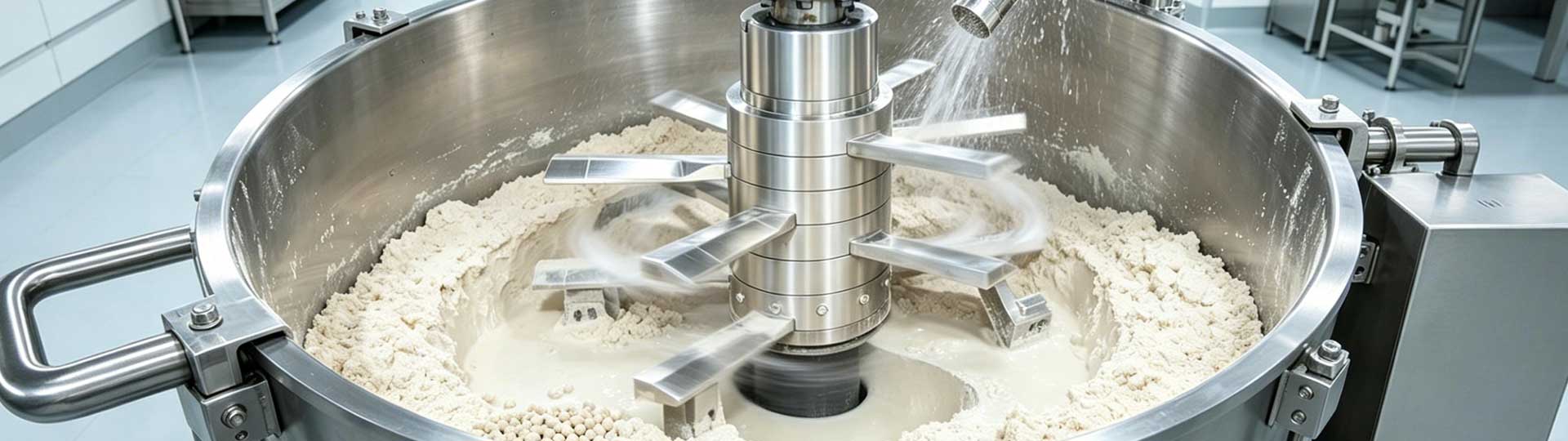
An intensive mixer is easy to describe and difficult to get right. The description is mechanical: a rotating pan, a high-speed rotor, a wall scraper, a discharge gate. The difficulty is that the machine’s value is never in its own geometry; it is in what happens to a specific material under a specific shear history, within a specific process window, at a specific point in a production line. A supplier who understands only the machine can sell a mixer. A supplier who understands the process can tell a customer whether the mixer is the right answer at all—and if it is, what has to happen upstream and downstream for the mixer to deliver what the plant actually needs.

Kontex’s equipment business is organized around that broader question. The company serves mineral processing, refractories, fine chemicals, metallurgy, fertilizer production, lithium battery materials, foundry sand, ceramics, and catalyst applications, and its stated capability is not limited to supplying individual machines but extends to process consulting, selection and design, manufacturing integration, commissioning support, and subsequent upgrades and retrofits. That scope matters because the failure mode in industrial mixing is rarely “the mixer broke.” It is more often “the mixer is doing what it was specified to do, and the specification was wrong for the material.”

The process literacy Kontex brings to that problem is grounded in the three mechanisms that any intensive mixer is trying to orchestrate: convection, shear, and diffusion. Convection moves material through the vessel in bulk; shear creates the relative velocity between particles that breaks down agglomerates and distributes binder; diffusion smooths concentration gradients at the small scale. A machine that overemphasizes one and starves the others will produce a result that looks mixed and behaves inconsistently—good average uniformity, poor batch-to-batch repeatability, or a granule structure that fails downstream. Kontex designs its rotor geometry and vessel interaction to drive all three in a single pass, which is why the company describes its mixing as three-dimensional counter-current mixing rather than a single-axis agitation.

That distinction becomes concrete in high-stakes applications. In lithium battery electrode materials, the relevant metric is not “is it mixed” but “is the coefficient of variation low enough that every batch behaves the same in the cell.” Kontex reports CV values below 5% in cathode and anode material mixing, with uniformity above 99.5%, and the equipment is used in closed systems that handle everything from micron-scale dry powders to high-viscosity pastes. In refractories, the requirement is different: the mixer has to wet out fine powders and aggregates with a binder without destroying the aggregate structure, so that the castable reaches the density and strength the application demands. A machine that mixes “uniformly” but over-shears the aggregate has failed the process even if the sample looks homogeneous.

This is where the distinction between a machine supplier and a process partner becomes operational. A process partner asks about the material’s particle-size distribution, the binder chemistry, the downstream forming or firing step, and the plant’s actual operating rhythm before recommending a mixer size or rotor configuration. Kontex’s engagement model follows that logic: the company positions its equipment business as covering process consulting, selection and design, manufacturing integration, and commissioning support, and it offers laboratory-scale mixing and granulation equipment so that a material can be trialed before a full-scale line is committed. That sequence—trial, then design, then build—is not a sales formality. It is the only reliable way to avoid discovering a process mismatch after the foundation has been poured.

The full-line capability follows from the same premise. Kontex provides solutions ranging from single machines to complete production lines and control-system integration, and its project scope includes process design, 3D production-line simulation, equipment supply, installation, commissioning, and after-sales support. For a customer building a new refractory line, a carbon-anode plant, a fertilizer granulation unit, or a battery-material preparation facility, the value of that scope is not that one supplier does everything. It is that the interfaces between unit operations—feed preparation, mixing, discharge, conveying, dust control, and control logic—are designed by the same team that understands what the mixer needs from upstream and what downstream needs from the mixer. Most line underperformance originates at those interfaces, not inside the mixer.

The industry perspective that ties this together is simple: intensive mixing is rarely a stand-alone purchase; it is a decision about how a material will be prepared for the next step in a value chain. A supplier who can read the material, read the process, and read the line is in a position to take responsibility for the outcome rather than for the equipment alone. That is the difference between selling a mixer and being a solution provider—and it is the standard against which Kontex asks to be judged.
Contact: Kevin
Phone: +86 15720553151
E-mail: azws@kontex-metco.com
Whatsapp:+86 15720553151
Add: No. 35, Gutan Avenue, Gaochun District, Nanjing, China